The Identity Stack: Four Layers for Recognizing Returning Shoppers
by Edward Upton
Most Shopify brands stop recognizing a returning customer about a week after their last visit. Fixing that takes a group of tools working together: an identity stack. Here are the four layers, the order to install them, and where each one stops.
A subscriber clicks your email on Monday, browses two products and leaves. Nine days later they come back from an Instagram ad, in Safari on their phone.
To Klaviyo, Meta and Google, that visitor is a stranger. No browse abandonment flow fires. The ad platforms cannot match the visit to a known customer. You have paid prospecting rates to reach someone already on your list.
Why known customers turn anonymous
Each marketing tool stores its visitor ID in a browser cookie. Safari and other WebKit browsers cap cookies set by JavaScript at seven days, and at 24 hours in some cases when the visitor arrives from a tracked link. When the cookie expires, the link between that browser and the customer's email address goes with it.
Safari on iPhone is a large share of traffic for most DTC brands. As a result, a large share of your registered customers look anonymous on every visit after the first week.
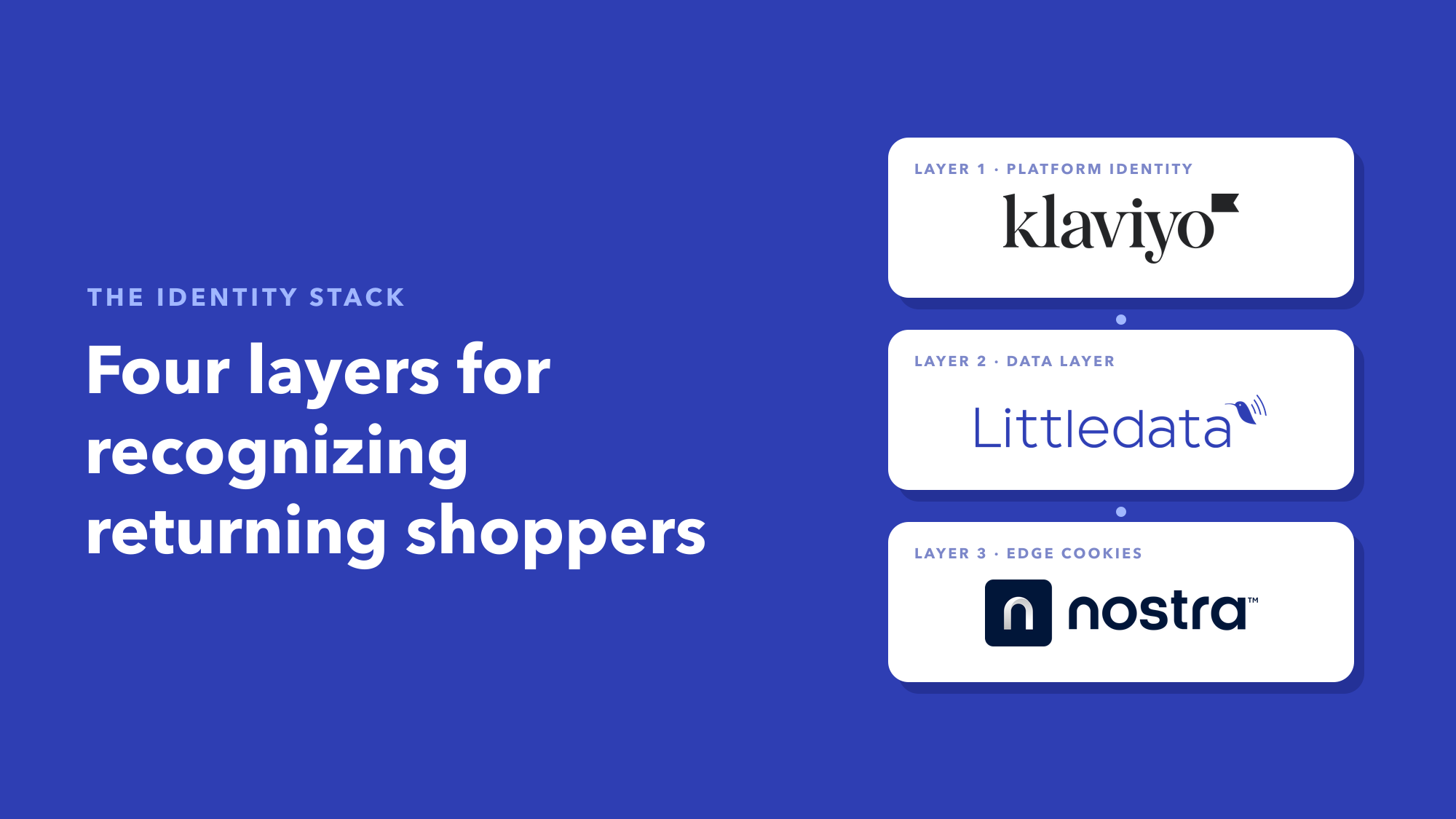
No single tool fixes this. Each layer below recovers a different group of visitors, and each makes the next layer more useful.
| Layer | What it does | Example | Where it stops |
|---|---|---|---|
| 1. Platform identity | Keeps the platform's own cookie alive for longer | Klaviyo Extended ID and First-Party ID | Works inside one platform |
| 2. Data layer | Shares identifiers and server-side events across channels | Littledata Persistent ID | Depends on the cookies that exist |
| 3. Edge cookies | Rewrites cookies as trusted, server-set cookies | Nostra AI Edge ID | Only recognizes people you have identified before |
| 4. Third-party resolution | Matches unknown visitors against outside data | Retention.com, Opensend | US only, and risks spam complaints |
Layer 1: switch on what Klaviyo already offers
Start with the platform's native tools. In Klaviyo there are two, and both are opt-in settings.
- Extended ID — Restores the Klaviyo cookie by reading identifiers that other platforms have already placed in the visitor's browser. Klaviyo says it can hold recognition for up to one year. It is available on all paid plans.
- First-Party ID — Runs Klaviyo's tracking from a subdomain of your own store. This sets a long-lived cookie from the server, which Safari trusts more than one set by a script, and uses it to refresh the Klaviyo cookie on each visit.
Neither is on by default, for two reasons. The first is legal. Klaviyo recommends that you reissue your cookie notice and review your privacy policy and terms before enabling either feature. The second is technical. First-Party ID needs a DNS record so that Klaviyo's tracking loads from your domain.
Neither feature identifies a new visitor. They keep the people you have already identified recognizable for longer.
Layer 2: share identity across every channel
Layer 1 improves recognition inside Klaviyo. Meta and Google still work from their own partial view of the same customer.
A data layer joins those views. Littledata's Persistent ID does this for Shopify stores. When a subscriber clicks an email, Klaviyo's identifier can be used to match that customer's later browsing and purchase events as they are sent to Meta and Google. The ad platforms then see a known customer, where before they saw an anonymous session.
Identity is only part of the job. A data layer also sends events from the server, so they are not lost to ad blockers or browser limits. Recognizing a visitor is worth little if the add-to-cart event never arrives, or arrives too late to trigger the flow.
This is the second layer because it works with first-party data you already collect, and because every later layer sends its extra identities through it.
Layer 3: make the cookies themselves last
The first two layers decide which identifiers exist and where they go. The third decides how long they survive.
Nostra AI's Edge ID sits in front of your storefront as a reverse proxy. It rewrites the cookies set by Klaviyo, Shopify, Meta and Google as server-set cookies from your own root domain. Browsers treat these as trusted and keep them for months.
You cannot add this on Shopify alone. Shopify serves your storefront, and it does not let a brand set these cookies from the server response for its domain. WebKit also applies expiry caps to some subdomain-based setups. A proxy on the main domain avoids both limits.
The result is that the identifiers from layers 1 and 2 keep working on the visits where they would otherwise have expired.
Layer 4: third-party identity resolution, in the US only
Everything so far is first party. It relies on data your customers gave to you.
A third-party tool such as Retention.com or Opensend goes further. It looks up an anonymous visitor against signals that person has given to other websites in its network. This can identify visitors that none of the first three layers can, including people who have never given you an email address.
It does work. Third-party resolution can grow your audiences in Klaviyo and in your ad platforms. I still think it is creepy.
Shoppers feel dirty when they find out their data is being traded between brands. They get emails from brands they never explicitly opted in to, and to them that is spam. Some of them will say so with the spam button.
That is where the cost lands. Even if the bigger audience lifts revenue for a while, the spam complaints can reduce deliverability across your whole sending domain. The customers who did opt in then stop seeing your emails too.
There are legal limits as well. This approach is available in the US. It is not permitted under GDPR, so it must stay off for visitors from the EU and UK.
Install the layers in order
Layers 1 to 3 recover customers you have already earned, using data you already hold. Layer 4 buys identities you have not, and it puts customer trust and email deliverability at risk.
Brands that start at layer 4 pay a vendor to identify visitors they could have recognized with a Klaviyo setting and a DNS record. Start with the tools you already pay for, add the data layer and extend the cookies. Buy the rest only if you accept what it costs you in trust.